
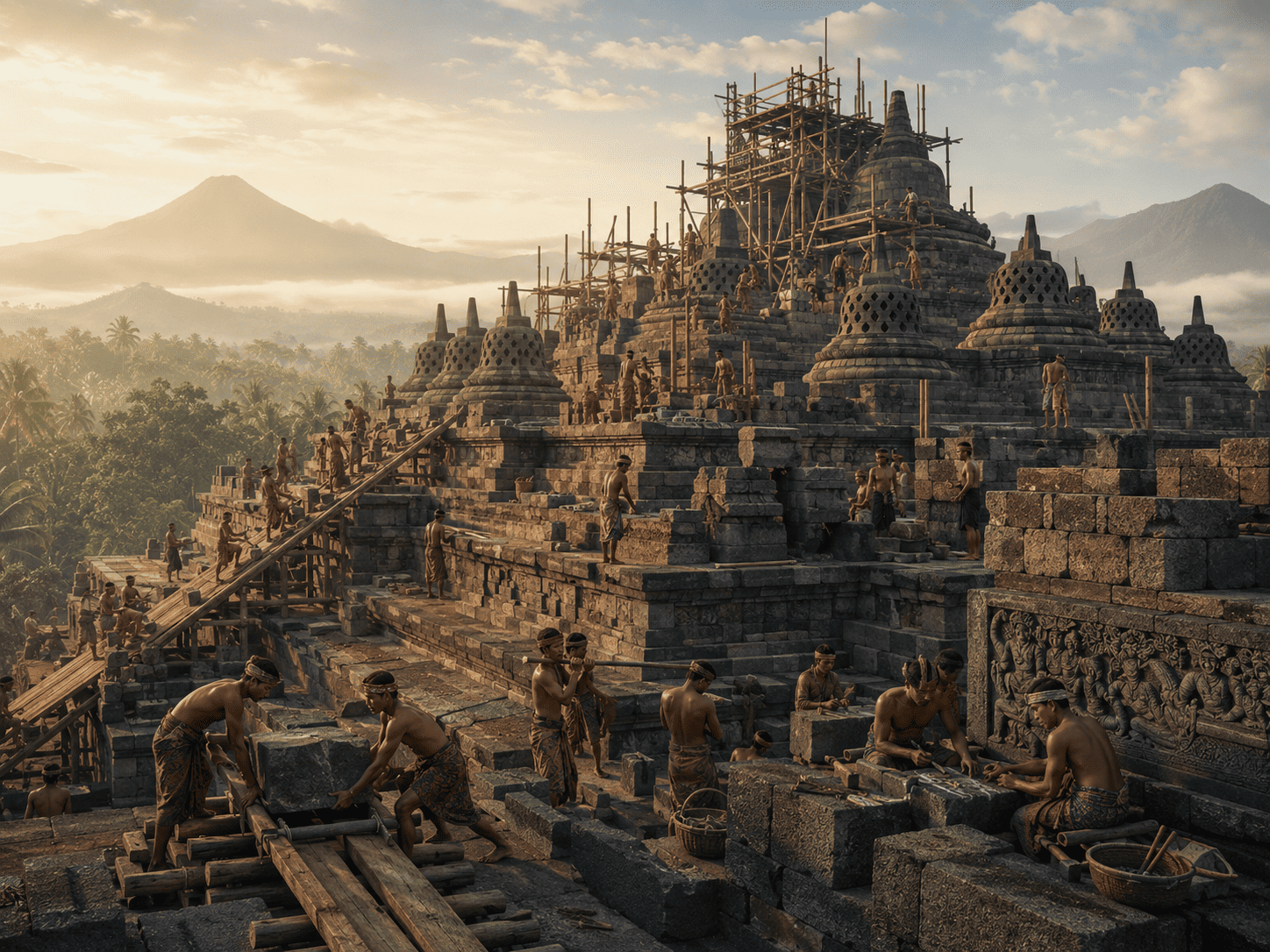
Many travelers ask, Who Built Borobudur Temple and how people in ancient Java created such a massive monument. Historians generally connect Borobudur with the Syailendra Dynasty, which ruled parts of Central Java during the eighth and ninth centuries.
However, no surviving inscription clearly names one architect or builder. For that reason, historians rely on archaeology, inscriptions, architectural evidence, and the political history of ancient Java.
The Syailendra Dynasty and Borobudur
The Syailendra Dynasty played a major role in the development of Buddhism in Central Java. During this period, rulers supported the construction of large religious monuments.
Borobudur most likely took shape under Syailendra patronage between the late eighth and early ninth centuries. The dynasty followed Mahayana Buddhism and supported Buddhist institutions across the region.
This historical setting explains why Borobudur contains Buddhist reliefs, Buddha images, stupas, and a symbolic layout based on Buddhist cosmology.
For more background, read our guide to important facts about Borobudur Temple. It covers Borobudur’s history, architecture, Buddhist meaning, and other important details.
Did King Samaratungga Build Borobudur?
Many historical discussions connect King Samaratungga of the Syailendra Dynasty with the later stages of Borobudur’s construction. He ruled during the early ninth century, when the monument may have reached completion.
An inscription from 824 CE, known as the Karangtengah inscription, mentions Samaratungga and a sacred Buddhist building. Scholars often use this record when discussing the political and religious context of Borobudur.
However, the inscription does not directly state that Samaratungga personally ordered every stage of Borobudur’s construction. The project may have developed over several decades and involved more than one ruler.
Was Gunadharma the Architect?
Indonesian tradition often names Gunadharma as the architect of Borobudur. Stories describe him as the master builder behind the monument.
However, historians have not found strong contemporary evidence that confirms this claim. No known inscription from Borobudur’s construction period clearly identifies Gunadharma as its architect.
For this reason, it is safer to describe Gunadharma as a traditional attribution rather than a proven historical figure behind the design.
Who Actually Constructed the Monument?
Thousands of skilled workers likely participated in the project. Stonecutters shaped volcanic stone blocks, while sculptors created reliefs, Buddha images, and decorative elements.
Engineers also had to manage the natural hill beneath the monument. They planned terraces, stairways, walls, and drainage channels to control tropical rainfall.
Craftspeople then carved extensive narrative panels across the galleries. The size and complexity of Borobudur suggest strong organization and long-term royal support.
The monument therefore reflects the work of many people rather than one individual builder.
Why the Builders Still Matter Today
Understanding who created Borobudur helps visitors appreciate its scale. The monument combines engineering, Buddhist philosophy, sculpture, and landscape planning.
Travelers who want deeper historical context can explore a private Borobudur tour from Yogyakarta. A local guide can explain the dynasty, architecture, reliefs, and spiritual meaning during the visit.
Seeing the monument in person also makes its construction achievement easier to understand.
Conclusion
So, Who Built Borobudur Temple? Historians mainly connect the monument with the Syailendra Dynasty, while King Samaratungga may have supported its later construction or completion.
Gunadharma remains part of traditional accounts, but direct historical evidence remains limited. In reality, Borobudur likely required generations of rulers, engineers, sculptors, and workers to create one of Southeast Asia’s greatest Buddhist monuments.
