
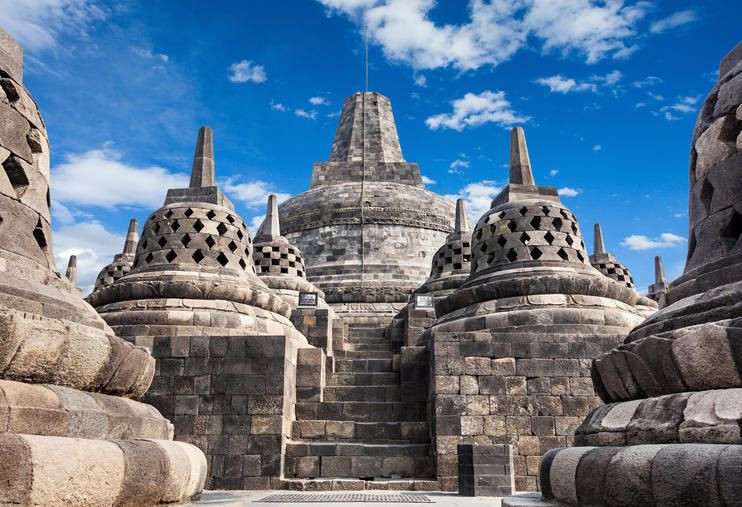
The Borobudur spiritual architecture reflects a close relationship between Buddhist philosophy, physical movement, and monumental design. Rather than functioning as a conventional enclosed temple, Borobudur guides visitors through terraces, galleries, stairways, stupas, and Buddha statues. Each architectural element contributes to a broader journey from the lower levels toward the summit.
Understanding Borobudur’s Sacred Design
Borobudur was designed with a carefully organized structure that rises toward a central stupa. The monument combines square terraces at the lower levels with circular platforms above them.
This changing architectural form creates more than a visual effect. It provides a structured path through which visitors gradually move upward.
The arrangement is commonly associated with Buddhist cosmology, making the physical structure an important part of the monument’s spiritual character.
Three Architectural Realms
Borobudur’s design is traditionally interpreted through three Buddhist realms: Kamadhatu, Rupadhatu, and Arupadhatu.
Kamadhatu represents the realm of desire and is associated with the monument’s lower section. Above it, Rupadhatu represents the realm of form and is expressed through the square galleries filled with reliefs and Buddha statues.
The upper circular platforms represent Arupadhatu, or the formless realm. Here, the architecture becomes simpler and more open, with rows of stupas surrounding the central stupa.
The Spiritual Journey Through Movement
One of the most distinctive features of Borobudur’s architecture is the importance of movement. Visitors ascend through the monument rather than entering a series of enclosed rooms.
Walking around each gallery and climbing the stairways creates a gradual progression toward the upper platforms. This movement can be understood as a symbolic journey toward greater spiritual awareness.
The architecture therefore connects physical activity with religious ideas. The visitor’s path becomes an essential part of experiencing the monument.
For a deeper look at how the monument’s structure, reliefs, and symbolic elements work together, this Borobudur inside guide provides additional information.
Reliefs as Part of the Spiritual Experience
The extensive reliefs found along the square galleries contribute to Borobudur’s spiritual architecture. They depict Buddhist stories, moral teachings, and various scenes that encourage reflection on human actions and their consequences.
Because visitors encounter these carvings while walking around the terraces, the artwork becomes part of the architectural journey.
The reliefs also create a transition toward the upper levels, where the amount of narrative carving decreases and the architecture becomes increasingly focused on stupas and open space.
Stupas and the Path Toward the Summit
The upper circular platforms contain numerous perforated stupas arranged around the central stupa. Their repeated forms create a calm and orderly architectural environment.
The Buddha statues inside many of these stupas remain partially concealed behind the stone lattice. This creates a contrast with the more visible Buddha statues found along the lower galleries.
At the summit, the central stupa becomes the dominant architectural element, providing a clear focal point for the entire monument.
Experiencing Borobudur’s Spiritual Architecture
The Borobudur spiritual architecture becomes easier to appreciate when visitors consider the monument as a complete journey rather than a collection of separate features.
Terraces, reliefs, Buddha statues, stairways, stupas, and the central stupa all contribute to the experience. Their arrangement creates a progression from detailed lower spaces toward the open upper platforms.
Travelers interested in exploring Borobudur and other cultural destinations in Central Java can discover more through Borobudur Tours.
Understanding this architectural concept can add greater meaning to a visit. Borobudur demonstrates how architecture can express religious ideas through structure, movement, artwork, and space, creating a monument that continues to inspire visitors centuries after its construction.
